
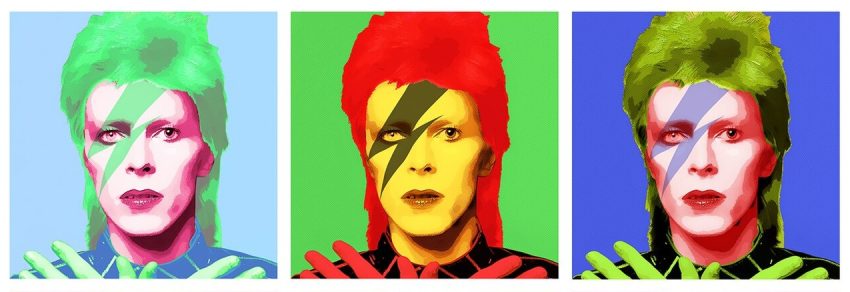

In 1968, space, the cosmos and everything they represented remained largely unknown and inaccessible to humanity: a place where the eye could lose itself and only the imagination could reach.
That same year, David Bowie began composing his own space odyssey, creating an idea of the cosmos shaped around our earthly fragility. The inspiration came from watching 2001: A Space Odyssey, which he would see several times in cinemas from 1968 onwards and which, as Bowie himself later recalled, triggered the creative process behind his most famous song.[i]
On screen, Stanley Kubrick had portrayed space as immense, silent and beautiful, but also profoundly sterile, cold and unsettling. The film presented interstellar travel as a technological, intellectual and psychedelic experience all at once, with astronaut David Bowman pushed beyond the limits of the known universe.
In Bowie’s imagination, space becomes the place where his first great character, Major Tom, finds himself alone and suspended in the immensity of the void, while humanity — seen from that perspective — appears infinitely small and powerless.
The single Space Oddity was released on 11 July 1969, just nine days before the first Moon landing. A few months later, on 14 November, the singer-songwriter’s second album was released in the UK under the simple title David Bowie. Only with RCA’s 1972 reissue would the record take the title by which we know it today: Space Oddity.[ii] It was while composing that song, destined to enter music history, that the English artist realised how the cosmos could become the perfect place in which to create and let his characters live, allowing him to observe the Earth from a privileged point of view. The rest of the album, in fact, deals with distinctly earthly themes — alienation, love, social criticism and disillusionment — concealed behind psychedelic sounds and folk-rock shades.
Bowie would keep his feet on Earth for three years and two albums (The Man Who Sold the World and Hunky Dory) before returning to the stars — or rather, before setting out from the stars and landing on our planet.
He does so by creating a new figure who, unlike Major Tom, would not be the protagonist of a single song but of an entire concept album: Ziggy Stardust. The Rise and Fall of Ziggy Stardust and the Spiders from Mars was released in 1972, accompanied by a band that took shape both on record and on real stages: the Spiders from Mars. Bowie drew on the myths of pop culture and the street to shape an extraterrestrial rock star with a science-fiction look, presenting himself to Earth as a messiah, with a theatrical charge and sexual fluidity unlike anything previously seen in popular music.[iii]
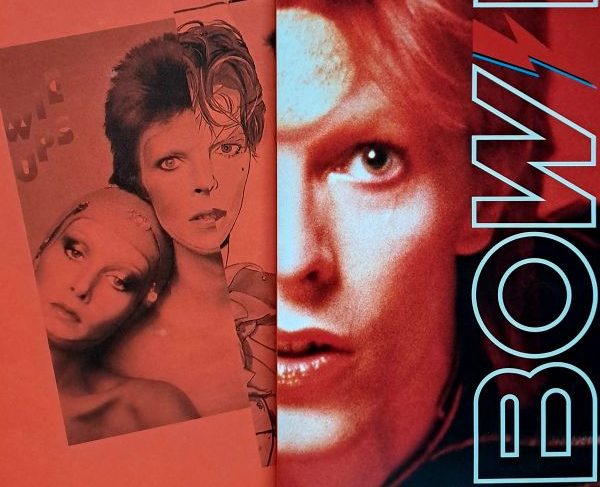
Ziggy is an intermediary between a dying planet and a hope that comes from the cosmos. Through his music he tells us what he sees first-hand, while at other times he is himself “narrated” through the album’s lyrics.
Space is the place he comes from; the atmosphere is earthly; and the music played by the “Spiders From Mars” is glam rock performed by a rock star destined to follow a terribly “human” trajectory, all the way to self-destruction and extinction.
Bowie does not simply play a role: he becomes the character. In July 1972 he brings Ziggy into British homes with his appearance on Top of the Pops to the opening notes of Starman: red hair, iridescent clothes, and a provocative, brazen physical attitude that shocks and fascinates an entire generation of British teenagers.[iv]
Forty-seven years and another 25 studio albums would pass from that 1969 starting point. Bowie would create numerous characters, some of them era-defining and none of them unnoticed, yet all firmly anchored to Earth. Only with his final work, Blackstar, does the artist symbolically decide to return to space. Here the cosmos once again becomes a mysterious and unknown place: the final destination of a personal and spiritual transformation. The album is dark, sombre and avant-garde, just like its symbol: a black star, “★”, which replaces a literal written title and for which Bowie would never provide a definitive interpretation. One particularly striking detail: on some vinyl editions, holding the gatefold up to the light reveals a field of stars that would otherwise remain invisible.
To construct the sonic universe of Blackstar, Bowie moves away from the traditional rock-band format and turns to New York saxophonist Donny McCaslin and his contemporary jazz quartet. After hearing them perform live at a New York club, Bowie sends them highly structured demos, upon which the musicians shape an intricate, dark and avant-garde musical fabric. Over these textures, Bowie layers reflections on mortality, rebirth, violence and the search within.[v]
Released just two days before his death, Blackstar has been widely interpreted as a moving spiritual testament. It is an understandable reading, yet one that risks reducing the album to a mere “epitaph”, when in fact this is a record that looks boldly towards the future, exploring new territory between jazz, art rock and electronic music.
1969 – Space Oddity and the loneliness of the cosmos
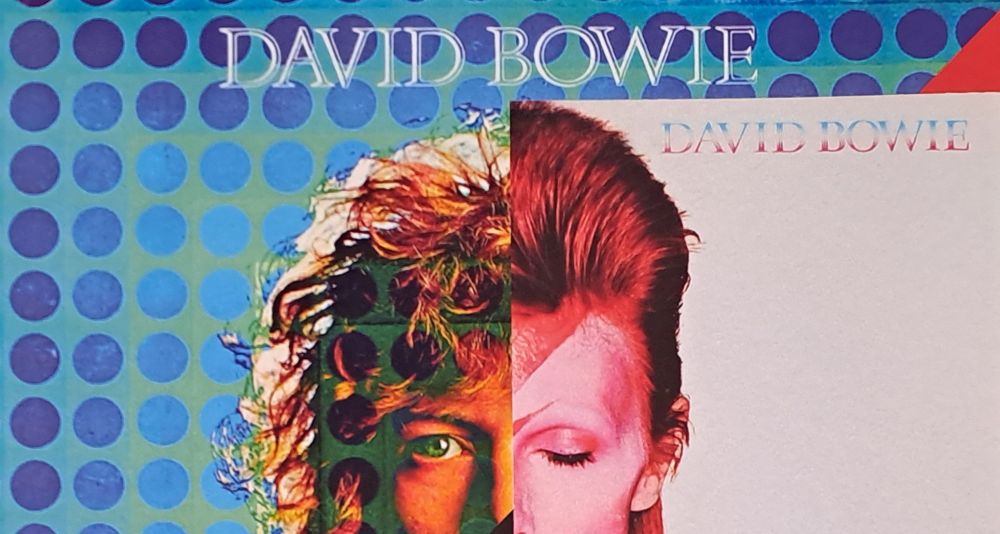
After the opening countdown, accompanied by an acoustic-guitar arpeggio, Bowie begins to tell us about his first character, Major Tom, floating somewhere in the universe. The song stages a radio dialogue between the astronaut and Earth’s Ground Control, whose bureaucratic instructions underline the smallness of human beings in the face of such an immense undertaking.
The young Bowie’s voice grows increasingly impassioned, while Paul Buckmaster’s string arrangements and Rick Wakeman’s Mellotron paint a suspended atmosphere. At the song’s emotional peak, Major Tom turns his gaze towards Earth and, in the face of humanity’s technological triumph, seems to accept with serene resignation his separation from the world that sent him into orbit. When communications fall silent and the song fades away, one unresolved question remains: has space swallowed its visitor, or has Major Tom himself chosen to lose himself in infinity?
David Bowie’s first great “cosmic” character thus ends his first appearance in the space of 5 minutes and 18 seconds, while opening the way for an artist who would become increasingly aware of his ability to create characters.
Ziggy Stardust (1972): The arrival on Earth
Five Years
The album Ziggy Stardust opens with Five Years, introduced by the spare pulse of the drums, followed by a light guitar arpeggio and finally Bowie’s voice, telling us that the Earth has only five years left to live. Supported by piano and an increasingly urgent orchestral crescendo, the singer’s voice grows ever more tense and desperate as surreal scenes unfold among the crowd in an ordinary English square.
Bowie thus opens the album without yet revealing the protagonist of the story, instead showing us a humanity that is weak, fragile and lost.
Moonage Daydream & Starman
It is Moonage Daydream that presents Ziggy in all his explosive force, driven by the guitar riff that opens the song and by the singer’s declaration that he is a space invader. It is the first building block in the construction of Ziggy’s extraterrestrial identity: Bowie does it through lyrics filled with violence, carnality and deliberately exaggerated, transgressive and science-fiction imagery, designed to burn themselves into the minds of those about to receive Ziggy’s messianic message.
Yet Bowie-Ziggy’s gentler side immediately re-emerges in Starman. This time the story begins with a boy who picks up a radio transmission from a “man from the stars” who, in a kind of cosmic dance, wants to speak and sing to humanity. Guided by Bowie’s calm, enveloping and slightly melancholy voice, supported by Mick Ronson’s clean guitar, we move from the verse into a chorus that suddenly bursts open, only to settle again in the second verse before rising once more in another crescendo. The message is clear: the man from the cosmos is waiting in the sky, eager to reveal himself and communicate through radio waves. But it is Bowie himself who physically brings Ziggy Stardust into British homes, embodying him on Top of the Pops in July 1972: flaming hair, iridescent clothes and Mick Ronson by his side. At this point the cosmos is merely the point of departure: Earth has become the stage.[vi]
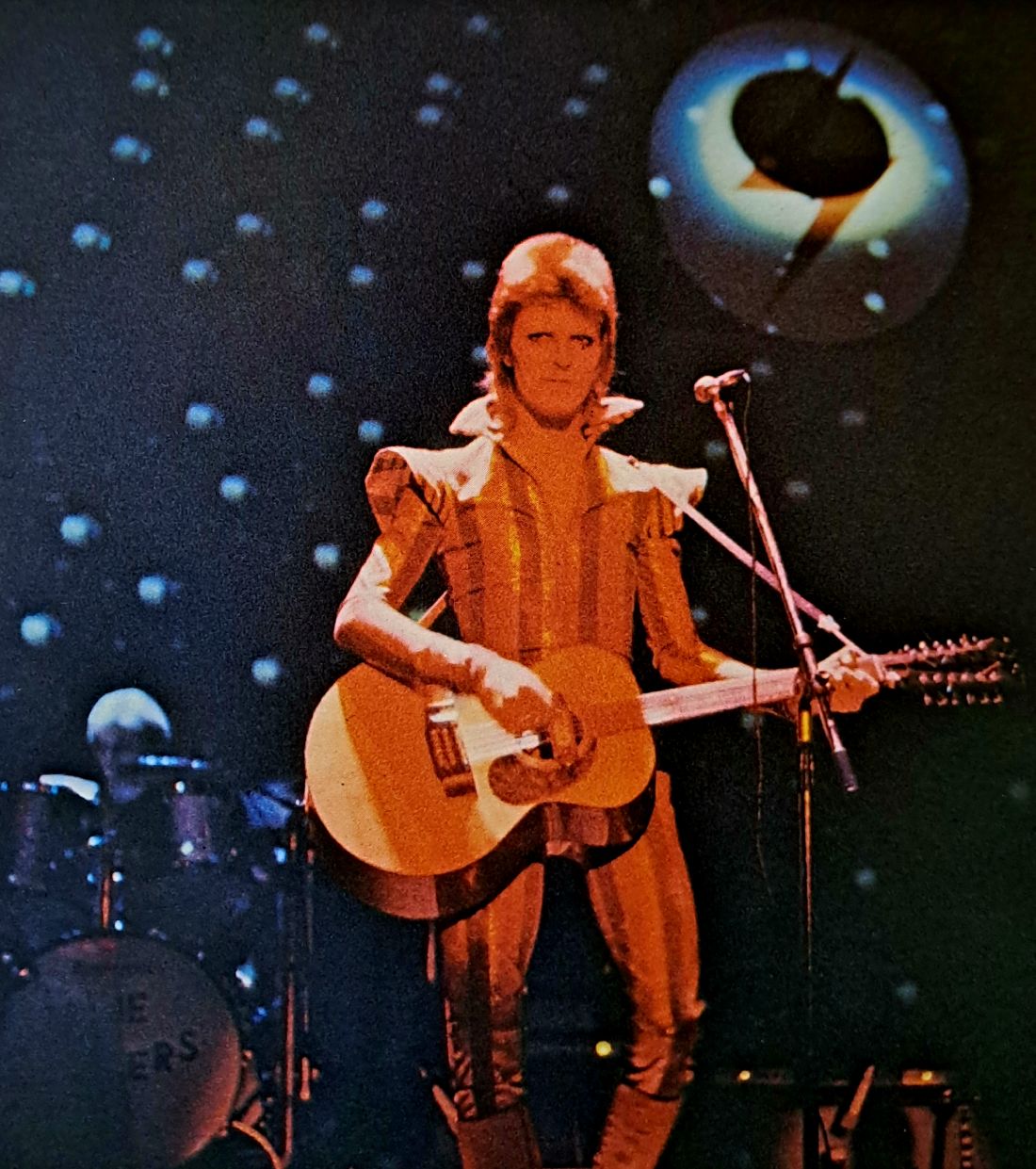
David Bowie as Ziggy Stardust during a concert
Ziggy Stardust & Rock ‘n’ Roll Suicide
Across this stage the album’s songs unfold until we reach track nine, Ziggy Stardust, where the myth of the alien is filtered through the eyes of his own bandmates. Built around the famous guitar riff that defines the song’s architecture, the lyrics show a Ziggy who has slipped so completely into the role of rock star that he becomes all too “human”, devoured by his own persona and driven towards inevitable self-destruction.
Although he carries the imagery of the stars with him, Ziggy has fallen in love with Earth and its inhabitants; he has tried to bring them salvation, but has become so captivated by them that he allows himself to be destroyed, falling into a downward spiral that culminates in the “suicide of Rock ‘N’ Roll”. Rock ‘N’ Roll Suicide is indeed the album’s farewell: an acoustic opening, supported by the artist’s aching, decadent voice, that grows beat by beat until the final explosion. Here Bowie cries out to his protagonist that he is not alone, almost invoking his redemption before the eyes of those who have loved him.
Blackstar (2016): The cosmos as the final destination
Blackstar
The black star that dominates the cover is both the symbol and the enigmatic metaphor of Bowie’s final masterpiece. It is with the title track itself that the artist chooses to open the album: a complex, twisted composition that immediately turns our gaze back towards the cosmos, portraying it as a dark and desolate place.
The song takes flight on electronic rhythms and unsettling percussion, over which Bowie’s mature voice recites enigmatic lyrics tinged with ritual. Sounds, layered voices, fragments of saxophone and cosmic synthesizers surround the listener in a dark, suffocating atmosphere. Halfway through, everything falls away and a shaft of melodic light opens up, almost liberating; a luminous interlude that is gradually absorbed once again by the Blackstar. The ritual darkness of the opening returns to swallow and slow the sounds, supported by a saxophone tracing strange, eccentric and almost disturbing melodies. Although the music alone already possesses an extraordinary visionary power, the Blackstar video, directed by Johan Renck, offers another key to interpretation: an alien planet appears on screen, its sun obscured by an eclipse, together with the lifeless body of an astronaut approached by a mysterious woman. In the director’s conception, that body is Major Tom, finally found at the exact point where his journey has reached its final destination.[vii]
With Blackstar, Bowie undertakes a truly cathartic journey: a passage from the initial darkness into light, only to plunge back into the dark, guided by enigmatic lyrics dense with ritualistic and esoteric echoes. It is a journey that takes place entirely within an alien and distant universe, both in its sonic textures and in the suggestive power of its words.
To find Bowie again in his most intimate and human dimension, we have to wait until the third track, Lazarus. Here the artist returns to Earth to deliver the song that many have described as his musical testament (although it was originally written for the stage production of the same name). The hypnotic bass that opens the track, followed by muted drums, a melancholy saxophone and oblique sonic textures, prepares the entrance of a voice that seems, for the first time, to reveal the full weight of age and personal fragility. The lyrics become almost autobiographical in their portrayal of the man: fragile, stripped of every mask, facing weaknesses he can now acknowledge without fear. The listening experience leads us towards a liberating finale, where the saxophone takes over and propels the song towards its conclusion, accompanied by slashes of electric guitar that tragically underline the performer’s farewell.
Finally, the seventh and last track seals the album: the deliberately enigmatic I Can’t Give Everything Away. Here an unusual brightness emerges in the sounds and atmosphere, dominated by keyboards and by lyrics through which Bowie seems to have led us by the hand all the way to the stars, without ever revealing what lies beyond.
From the New York room where the song was recorded, our gaze rises upwards: it crosses the blue sky, growing darker and darker as it approaches the stratosphere, until the curvature of the Earth’s horizon comes into view. Then only the blackness of the cosmos. The stars.

Artwork for Lazarus, a single taken from Blackstar (2016).
[i] https://www.davidbowie.com/blog/2018/5/10/2001-a-space-odyssey-is-fifty?
[ii] https://www.davidbowie.com/2009/2009/08/12/space-oddity-40th-anniversary-edition?utm
[iii] https://www.davidbowie.com/the-rise-and-fall-of-ziggy-stardust-and-the-spiders-from-mars?utm
[iv] https://www.davidbowie.com/2015/2015/08/15/five-years-box-album-4-ziggy-stardust?utm_source
[v] https://www.davidbowie.com/blackstar?utm
[vi] https://www.davidbowie.com/blog/2022/7/6/starman-on-totp-fifty-years-ago-today?utm_source
[vii] https://www.davidbowie.com/blog/2025/11/20/-blackstar-single-is-10?utm_source
PHOTO CREDITS
Photograph of a Bowie Print: Claudio Mauro, 2026
Photographs of the vinyl record and copy of The Rise and Fall of Ziggy Stardust and the Spiders from Mars: Claudio Mauro, 2026
Photographs of the vinyl record and copy of Blackstar: Claudio Mauro, 2026
Photographs of the vinyl record and copy of Legacy: Claudio Mauro, 2026
Artwork for Lazarus, a single taken from Blackstar (2016). Original image: Scraben / Wikimedia Commons — CC BY-SA 4.0 — cropped image