
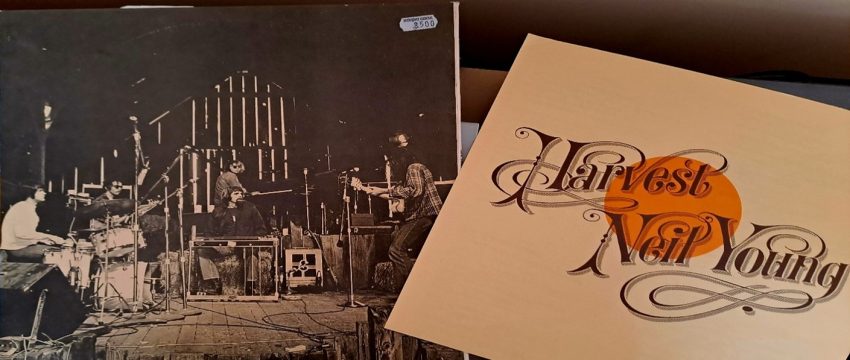

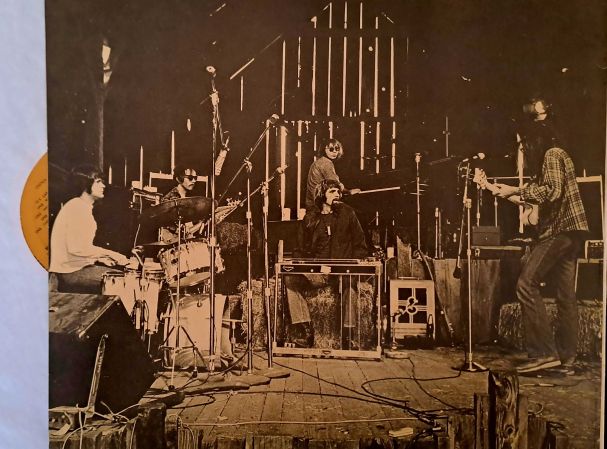
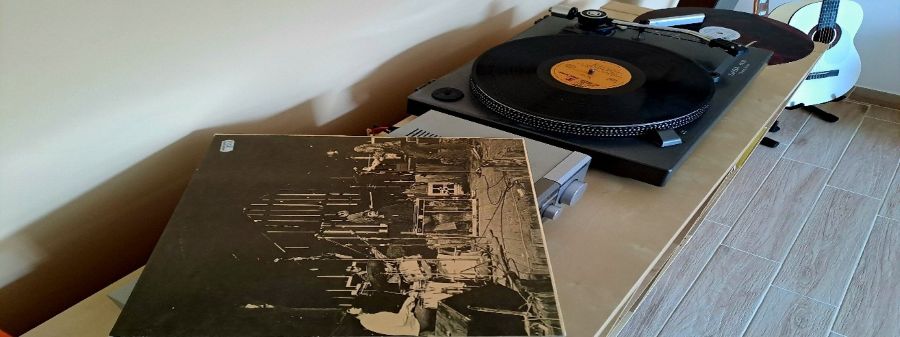
Inside, there is a warm light, coming from the wheat fields, reflected and filtered through the wooden boards of an old barn. Straw and hay fill the air with their scent of sun, earth and dust. In the background, musical instruments lie around in no apparent order, waiting to be picked up; at the centre stand four men. Outside stretches the American countryside, rural and folk, entering through those walls and dwelling in the heart of the fifth musician, the one everyone is looking at.
The image on the back cover of the Harvest vinyl tells all of this. It is not simply a staged photograph: it is the visual synthesis of the album’s spirit, its roots and the atmosphere that runs through every song.
BEHIND THE BARN
It is 1970 and Neil Young is already a leading name in an America immersed in folk and rock. He has three solo albums behind him and is coming off the success of After the Gold Rush — acclaimed by critics as one of the genre’s landmarks — as well as the extraordinary tours with the supergroup Crosby, Stills, Nash & Young, which he has recently decided to leave. All this before even turning twenty-five.
At precisely that point in his career, anyone might expect a headlong rush towards superstardom. Young, by contrast, soon shows his impatience with traditional promotion, obligatory interviews and the logic of the record industry, refusing to reproduce the formula for success by design.[1]
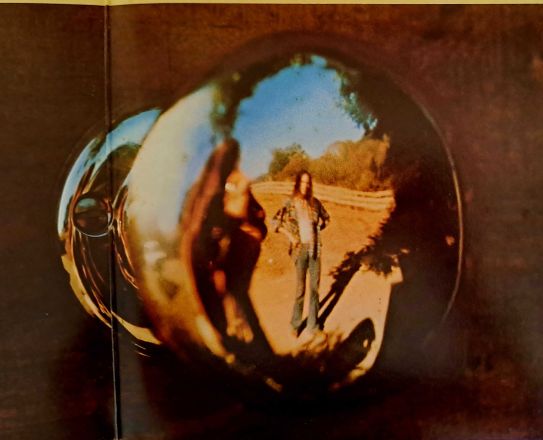
It is in this climate of rupture that his relationship with actress Carrie Snodgress begins, and the two share a desire for privacy. Neil feels the need to find a refuge away from the spotlight, somewhere to nurture their relationship and create new music. At the end of 1970, Young buys a large property in La Honda, among the mountains of Northern California: the Broken Arrow Ranch. More than simply a home, the ranch becomes the centre of gravity of his life: it sets the rhythm of his days, shapes his inspiration and gives form to the rural imagery that is searching for its own voice. Only one decisive spark is still missing to turn that quiet into a masterpiece: an unexpected journey into the heart of country music, to Nashville.
FERTILE GROUND
If Harvest is so deeply rooted in rural America, much of that is owed to Nashville. Nashville is the ancient tree from which much of the American country tradition has grown, and Harvest is one of its most fertile branches. It is here that the singer-songwriter meets producer Elliot Mazer almost by chance, along with the group of musicians destined to define the album’s sonic identity.
In February 1971, Mazer immediately senses the potential of Young’s new songs and opens the doors of the Quadrafonic Sound Studio to him, a studio built inside an ordinary residential house. Far removed from the image of the great Los Angeles studios, that intimate setting immediately wins Neil over: there he finds the closeness he has been looking for. He is also introduced to extraordinary Nashville session musicians, players accustomed to getting a take right the first time, listening to one another and always putting the song before virtuosity. The chemistry is perfect: masterpieces such as Old Man and Heart of Gold take shape during these sessions.[2]
The understanding created in the studio is so strong that Neil and Mazer decide to move the rest of the production directly to the Broken Arrow Ranch. In just a few days, Mazer transforms the property’s old barn into an improvised recording studio. It is neither acoustically perfect nor soundproofed, but that roughness is precisely what fascinates Young. Without filters or technical superstructures, the musicians play together live, allowing the space and the spontaneous dialogue between their instruments to shape the album’s unique sound.
THE HARVEST
There is something curious and moving about Harvest. Its roots reach deep into the American musical soil, made up of folk, country rock and the celebrated Nashville Sound. The lyrics, too, grow out of that rural imagery of men, women, landscapes and everyday stories. Neil Young completes this journey by bringing the recording studio into the very place where his music found fertile ground in which to grow.
Perhaps this is the album’s secret: the Californian countryside, life on the ranch and that spontaneity end up entering the songs themselves, becoming an integral part of their sound and identity.
01. Out on the Weekend
The album opens with Out on the Weekend, where a warm, sly harmonica, accompanied by acoustic guitar, bass and drums, anticipates Neil’s voice. In a calm, slightly languid tone, Young tells the story of a young man who sets off in a pick-up truck to rebuild his life, leaving behind a woman who perhaps still loves him. His voice intertwines delicately with the instruments without ever being overwhelmed by them. It is pure folk, with masterful instrumental work: Ben Keith’s pedal steel does more than simply accompany the melody; it seems to widen the song’s horizon, transforming a few simple chords into a boundless landscape.
02. Harvest
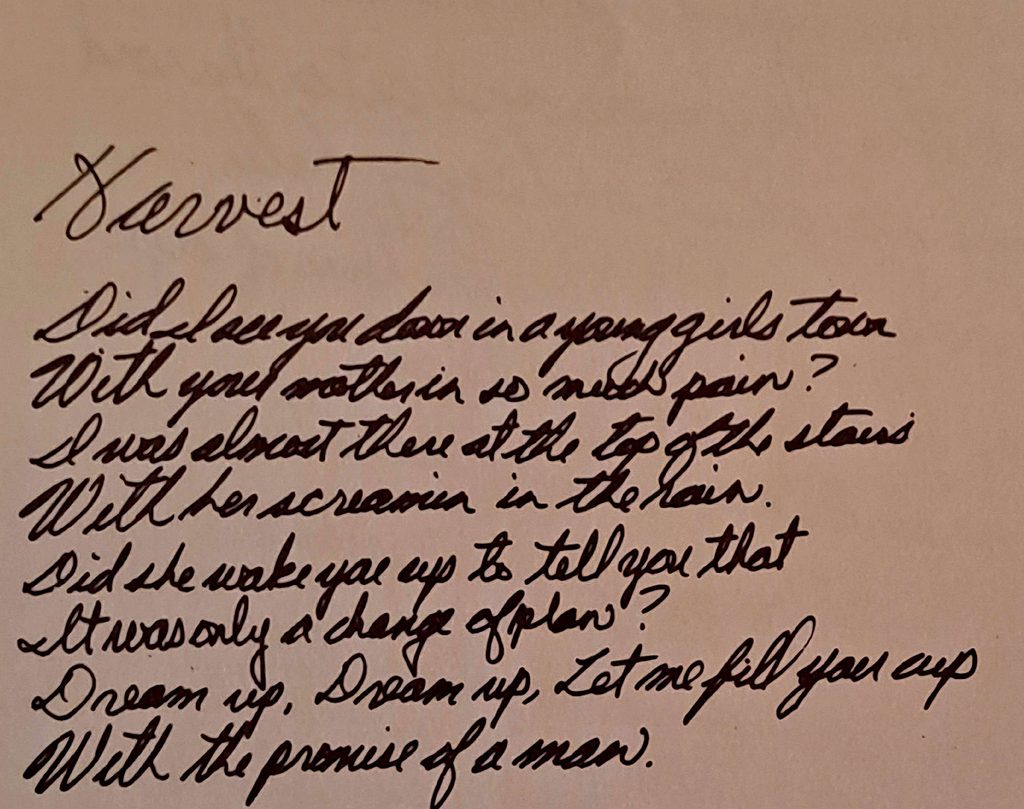
The title track carries the album forward. The lyrics evoke a man standing at the foot of a dimly lit staircase, inside an old house with wooden walls and faded wallpaper. At the top of the stairs stands his woman; below, the protagonist remains with lowered eyes and hunched shoulders — like someone who submits without resisting, through laziness or habit — questioning his ability to keep his promises and to truly be worthy of that love. The song’s verses, framed as a continuous series of questions, are supported by a measured rhythm that creates a suggestive sense of languor. Kenny Buttrey’s drums keep time without ever imposing themselves, while the pedal steel remains discreetly in the background, as though accompanying the protagonist’s thoughts rather than simply the melody. The result is a beautiful folk song in which music and words merge.
Recorded directly at the Broken Arrow Ranch studio — a place that played a decisive role in shaping this atmosphere — the story has long been regarded as a semi-autobiographical reflection of the singer-songwriter’s relationship with actress Carrie Snodgress.
03. A Man Needs a Maid
The third track is a completely singular element within the album and remains one of its most debated songs. The opening piano and Neil’s gentle voice convey the fragility of personal change — with the beautiful image of shadows moving through life like a beggar going from door to door — creating an almost heartbreaking atmosphere. The tone changes dramatically, however, with the entrance of the London Symphony Orchestra, which transforms the song into something grandiose and cinematic. The contrast with the intimacy of the preceding tracks is striking: the band’s acoustic textures give way to an imposing crescendo of strings, a bold production choice that Young himself has always defended with pride.[3]
04. Heart of Gold
Probably no other Neil Young song has managed to turn such a simple melody into such a universal anthem. The track begins with guitar, bass and drums, immediately joined by the harmonica: aching, immediate, enough to send a shiver down the spine. Young’s voice sings in a confident, warm and melancholy tone, telling a story that feels rooted in the American heartland. The flourishes of the acoustic guitar underline the ends of the verses, while the pedal steel becomes almost a third voice, guiding the song towards its conclusion. The track seems to “breathe” continuously through pauses and restarts, allowing images of struggle, hope, broken dreams and dreams rebuilt to emerge. Here the “heart of gold” is not dedicated to one person, but to the search for beauty, sincerity and humanity hidden deep within each of us.
05. Are You Ready For The Country?
Listening to this track, it is easy to picture the musicians inside the barn: the atmosphere is relaxed, instruments are being tuned and a few final words are exchanged before the live take begins. The piano starts by striking the keys with purpose, immediately followed by a wonderfully warm bass, the drums and the pedal steel. Cheerful and carefree in tone — although the lyrics conceal a subtle criticism of the hardships of rural life, so far removed from urban comforts — the track works as a moment of release, a genuine declaration of love for country music and for that Nashville sound that provided such fertile ground for the entire album.
06. Old Man
Four banjo notes are enough to understand that Old Man belongs to the history of American music. The drums enter and the bass follows their momentum, building the climax of a song that fills with energy and vibrates with intensity. Young sings about an older man — Louis Avila, the ranch’s caretaker — creating an imagined dialogue between his own generation and that of his fathers.[4] The six-string banjo anticipates the arrival of the chorus with just a few notes, where the backing voices are once again accompanied by pedal steel. The song carries this energy forward before settling back into calm at the end, when Neil’s acoustic guitar and voice, woven together with a few piano notes, reclaim the foreground before the close. Alongside the title track and Heart of Gold, this song symbolises the extent to which the album is rooted in the nation’s folk tradition: Old Man embodies the very idea of “Americana”, even before the term became a fully fledged musical genre.
07. There’s a World
With the seventh track, Neil Young temporarily sets aside Harvest‘s rural character. If until now the album’s gaze has remained fixed on the earth, There’s a World invites us, for the first time, to lift it towards the sky. To do so, the singer-songwriter once again turns to the London Symphony Orchestra, which takes on an even greater role here than in A Man Needs a Maid, transforming the song into something intensely cinematic, grandiose and spiritual. Between the solemn timpani strokes that mark its most intense passages and the strings that embroider the melody, the song seems to reach towards something higher and more distant, while Young’s voice accompanies the listener on this search. Within the album’s sequence, There’s a World acts as a contemplative pause before Alabama turns its gaze back towards the earth and sets the album on the road to its conclusion.
08. Alabama
If up to this point the singer-songwriter has accustomed us to traditional, acoustic and delicate sounds, Alabama bursts in with an electric-guitar arpeggio. The break from what came before is immediate, and the song’s different energy can be felt at once, driven by the urgent entrance of drums and bass. Neil’s voice cuts through the guitar’s initial force as he describes the state and questions its deep contradictions. The intensity grows towards the chorus, where backing voices support the singer before disappearing and returning shortly afterwards. This time the subject is not the everyday lives of ordinary people: Young turns to social and racial issues, confronting the listener with the doubts and shadows hanging over this region.
09. The Needle and the Damage Done
Recorded live in 1971 and never re-recorded in the studio, the song is the painful testimony of an artist who has lost friends, colleagues and bandmates to drugs, heroin in particular.[5] To tell this story, Neil relies only on his acoustic guitar and voice: a stripped-down arrangement lasting little more than two minutes. The decision never to re-record it in the studio proves perfect: no other version could have captured the same fragility as that performance before an audience. The roots of the American folk tradition return in their purest form, with an artist laying himself bare in a direct, unfiltered performance.
10. Words (Between the Lines of Age)
A direct, electric attack, without introduction, opens the final and longest track on Harvest. The singing becomes more assured, less hesitant, almost as though determined to bring the album to a decisive close. The pedal steel continues to embroider the melody while the electric guitar adds distorted accents to the most emphatic passages. The rhythm slows during the chorus, giving it even greater weight and intensity, before the musicians turn the song into a small rock suite. Neil’s voice returns in the final two minutes to complete the story: for the last time on the album, the singer returns to those rural images, allowing them to work on the listener’s imagination while the musical backing gives them life and depth.
Once the final line has been sung, the song slowly fades as the instruments drift away. Words (Between the Lines of Age) is Harvest‘s long final tracking shot. The camera slowly pulls back, leaves the barn, crosses the ranch yard and leaves the musicians playing in the background. The sun sets over the Californian countryside as the instruments fade with the last notes of the record. When the final sound disappears, what remains is not the feeling of having finished an album, but of having moved away from a physical place, intimately rooted in the soil from which that music was born.
SOURCES
1. Young and Unlovely – The Guardian
2. Elliot Mazer: Neil Young’s Engineer on Classic Recording – Tape Op; Elliot Mazer, Producer of Neil Young’s Harvest, Dead at 79 – Pitchfork
3. 1971 Film of Neil Young Recording “A Man Needs A Maid” with the London Symphony Orchestra
4. Neil Young on his greatest hits – Uncut
5. Neil Young – Royce Hall 1971 – Warner Records
PHOTO CREDITS
Photographs of the vinyl record and the copy of Harvest: Claudio Mauro, 2026